
This is a blog on all things related to my book project, currently titled “The Rooted State: Plants and Power on the Frontiers of Modern China.” Scroll down to see my posts!

New Article with Tristan Brown, “Lost Rural Futures: Agrarian Nationalism and Industrial Dissent in Modern China”
“I love you too,” the American president declared to farmers in his address to Congress last night. From Trump’s address to the national emblem of China and the fictional flag of Panem in the “Hunger Games” films… why is there so much agrarian symbolism in our nationalism? Where does this sort of “agrarian nationalism” come from?
Approaching this topic from the angle of twentieth-century China, Tristan G. Brown and I have just published an article entitled “Lost Rural Futures: Agrarian Nationalism and Industrial Dissent in Modern China” in the journal Comparativ. Here is the abstract:
A debate in the early 1940s between two social scientists, Yang Kaidao and Zhou Xianwen, reinvigorated a national conversation about China’s relationship with agriculture. Clearly China’s roots were agrarian, but was it destined to remain “a country founded on agriculture,” in which the rural village remained the focal point of the state and the nucleus of society, or must the republic industrialize in order to survive? If the answer seems obvious to the present-day observer, it remained debatable on the eve of the Communist revolution. This paper uses the Yang-Zhou debate as a window on past visions of an agrarian future that were impassioned yet full of irony: agricultural fundamentalists pointed to settled agriculture as a distinctive and transhistorical feature of the Chinese state, but their arguments and policy recommendations echoed similar movements in Japan, Italy, Latvia, and many other twentieth-century states. We argue that we ought to recognize China’s twentieth-century agrarian fundamentalism as both an understudied fulcrum of Chinese nationalism, and a node in a global agrarian-nationalist movement that mostly fizzled out after World War II.
And here is a preprint of the article for those who do not have access to Comparativ:


New Publication on the history of Chinese climate science in History of Science
Update: “National Climate: Zhu Kezhen and the Framing of the Atmosphere in Modern China has now been published in History of Science 62(4), pp. 562-590. You can access the published version is here (requires login).
Here is a preprint version of the article.
***
My article “National Climate: Zhu Kezhen and the Framing of the Atmosphere in Modern China” has been published in History of Science. In this article, I argue that nationalism was more than an impetus for developing scientific institutions in the early 20th century: to some extent, the nation was baked in to the methods of climate scientists, while their findings lent support to the idea of “China” as a natural object. Here’s the abstract:
Can climate be Chinese, and if so, then how? Drawing on personal writings, popular discourse, and scientific reports, this essay considers the work of early Chinese meteorologists in relation to the revolutionary national politics of the early twentieth century. Historians of China have established that nationalism motivated the pursuit of meteorology and other natural sciences, but I advance the more radical position that there was no clear distinction between the practice of climate science and the political ideology that motivated it. With special attention to the career and legacy of Zhu Kezhen from the Xinhai Revolution through World War II, I test this thesis in two arenas: Chinese meteorologists’ production of spatial knowledge, and their production of cultural knowledge. The nation was integral to the questions, methods, and analyses of atmospheric science, which helped to reify the Chinese nation-state.
New publication: Frontier Atmosphere
In the spring of 2016 I was doing dissertation research at the Sichuan Provincial Archives when I discovered a trove of letters between meteorological observers and their supervisors during the 1940s. Originally, I had planned to briefly consult the meteorological archives to get a sense of weather patterns in the vicinity of Kangding (or Dartsendo), but the meteorological record was an absolute mess: there was little data, but a lot of correspondence about personnel problems and missing or broken equipment.
I was particularly fascinated with the case of a young man with tuberculosis who joined the weather service in 1938, then suffered miserably from coughing fits during his time in Kangding, and pleaded for months with the Central Meteorological Bureau to be relieved from his position. There were many similar petitions from other personnel, and I realized that I’d found something rare: long, detailed testimonies from Han settlers who were absolutely miserable on the frontier.
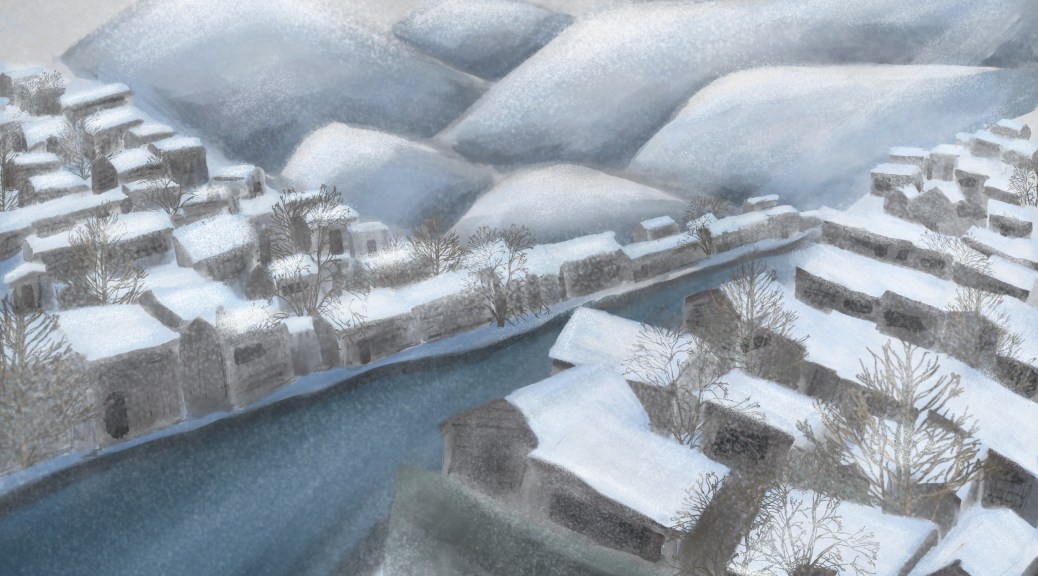
I ended up devoting a whole chapter of my dissertation to the Kangding weather service, but it was a poor fit with the rest of the dissertation. Fortunately, I’ve spun it off as an article in a forthcoming special issue of The British Journal for the History of Science on meteorology in Asia. Included are two beautiful, full-color illustrations by artist Luodan Rojas–including the one in this post depicting Kangding during a winter storm in 1943. For now the article available on an open-access basis through Cambridge University Press’ FirstView feature:
“Frontier Atmosphere: Observation and Regret at Chinese Weather Stations in Tibet, 1939-1949.”
My Year at Yale: a Debriefing
From fall 2020 through summer 2021 I was the CEAS Postdoctoral Associate and Lecturer in the Environmental Humanities at Yale University.
After a long year adjuncting at a struggling college that has since failed and while contemplating an unpaid career as a Microsoft Flight Simulator pilot, I learned that my application to a postdoc position at Yale was successful, which meant I got to continue my research while wearing a Yale hoodie without irony. That’s not all: as the CEAS Postdoctoral Associate in the Environmental Humanities, I had the opportunity to teach an undergrad seminar on the Environmental History of East Asia, I helped to lead a graduate seminar, I joined the Environmental Humanities Steering Committee, and I forged ahead with my book project and several articles. I also joined the wonderful, one-of-a-kind Program in Agrarian Studies as an affiliate fellow.
Postdocs often feel disconnected from the rest of the university, or so I hear, but that wasn’t my experience. The Council on East Asian Studies and the Environmental Humanities Program did an incredible job of making me feel like a part of the community during my time here. My students were the best I’ve had yet, and reading their well-researched papers was an absolute pleasure. I’m convinced that this combination of research, light teaching, and some committee work is exactly the right way to structure a postdoc; it was certainly helpful in job interviews.
The pandemic meant that I spent less time on campus than I would have liked, but then I’m reminded of the false (yet inspiring) notion that the Chinese word for “crisis” combines the words for “danger” and “opportunity”: specifically, virtual events and teaching created opportunities for long-distance conversations and made Yale programming more accessible to the world. People Zoomed in to the Agrarian Studies Colloquium from abroad on a regular basis (including several who beamed in from India). In the spring semester, my co-instructor and I were able to arrange 10(!) excellent guest speakers for a graduate seminar that met five times. These are things you can’t do with entirely in-person programming.
This week I’ve been making daily trips to Sterling Memorial Library for archival research. As the alumnus of a state school with aggressively plain architecture, I am enjoying my gothic surroundings (even if they were built with oil money).
I got a lot done this year with support from CEAS and Environmental Humanities: I made serious progress on my book, I published one article that I’m particularly fond of, and I submitted another. So, thank you!

Remembering Liu Manqing on International Women’s Day
Happy International Women’s Day!
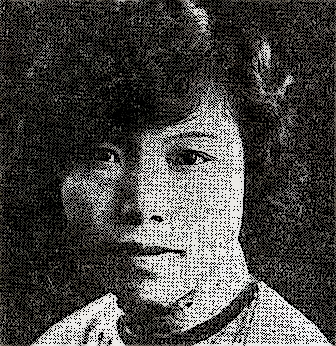
Of all the people who figure in my dissertation, my favorite is Liu Manqing 劉曼卿 (1906-1941). Born to a Han Chinese father and Tibetan mother, she married young at the urging of her father, but then divorced her husband and went back to school in pursuit of a nursing career. When she realized nursing wasn’t for her either, she decided at age 23 to undertake an overland journey from China proper to Lhasa to meet with the 13th Dalai Lama, with the vague goal of improving Sino-Tibetan relations.

Liu obtained the blessing of Chinese (ROC) president Chiang Kai-shek before setting off for Lhasa, but the trip was of her own initiative and was not an official diplomatic mission. She was a member of the Guomindang (Nationalist Party) and an impassioned believer in Sun Yat-sen’s “Three Principles of the People” and the Guomindang vision of the “unity of the five races”–referring to the Han, Manchus, Hui, Mongols, and Tibetans. Yet at times she was harshly critical of Guomindang implementation of that vision, which typically emphasized assimilation of ethnic minorities into the Han majority.
As Liu’s riverboat traveled up the Yangtze in 1929, she reflected on her difficulty relating to most of the other women in her cabin. Her travel memoir recalls:
I thought upon my cohabitants in this small cabin, these women with whom I am coeval, and of my attending to the affairs of the nation and their attending to the affairs of the home, laden with heavy hearts and under pressure all day long. Although some of our affairs are great and others small, some are public and others private, yet they all occupy us equally and are similar in this respect. (Liu Manqing 1933, p. 4)
Liu Manqing played an active role in Sino-Tibetan relations until her death of illness at age 35. For more on her life, see Fabienne Jagou’s article “Liu Manqing: A Sino-Tibetan Adventurer and the Origin of a New Sino-Tibetan Dialogue in the 1930s” in Revue d’Etudes Tibétaines no. 17. Liu also features heavily in chapter three of my dissertation.
 Mark E. Frank